Elegant Christmas Snowflake
First Impressions: Delicate, Festive, and Quietly Confident
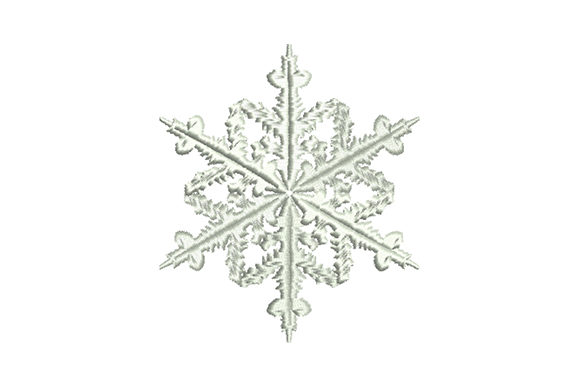
When I opened the Elegant Christmas Snowflake embroidery file, what struck me wasn’t flash—it was balance. The design carries a quiet elegance that avoids cliché: no oversized glitter effects, no cartoonish curves, just clean radial symmetry with subtle variation in petal weight and spacing. It feels hand-drawn but machine-precise—like something you’d sketch on tracing paper before digitizing it yourself. That’s rare. Most holiday snowflakes lean either too ornate (overwhelming for small hoops) or too minimal (losing character at 3 inches wide). This one lands right in the middle: detailed enough to read clearly at 2.5”, refined enough to scale up to 4.5” without bloating.
A Real Project Test: Embroidering It on a Linen Tea Towel
Last week, I used Elegant Christmas Snowflake on a set of heavyweight linen tea towels for a local boutique’s holiday collection. We stitched it centered on the lower corner, paired with a single monogrammed initial in matching thread. No extra text. No borders. Just snowflake + name. Customers responded immediately—not with “Oh, how cute!” but with “That’s *exactly* the kind of thing I buy for people who hate ‘cute’.” That tells me this design works as a quiet signature, not a seasonal shout. It reads as intentional, not decorative filler.
Where It Shines—and Where It Needs Thought
Elegant Christmas Snowflake excels on stable, medium-weight fabrics: cotton twill aprons, brushed cotton sweatshirts, canvas tote bags, and pillow covers with tight weaves. On those surfaces, the satin stitch edges hold crisp definition, and the fill stitch density feels generous without puckering. I’ve tested it on baby onesies using lightweight cutaway stabilizer—and yes, it held up cleanly, though I recommend avoiding the very center petal cluster on ultra-thin interlock knits unless you reduce stitch density manually.
It’s less forgiving on highly textured fabrics like bouclé or thick terry cloth—the delicate outer points can disappear into the pile. And on curved surfaces like structured caps? Possible, but only if you’re willing to split the design across two smaller elements or use a low-profile hoop with precise placement. Don’t force it onto a baseball cap front unless you’re stitching it at 1.8” max and reinforcing every petal tip with a tiny running stitch anchor.
Dark fabric is where this design truly earns its keep. In navy, charcoal, or deep forest green thread, the contrast stays soft and sophisticated—not harsh or graphic. But on light fabric? Test your thread color carefully. A stark white-on-ivory combo can look washed out. Try ecru, heather gray, or pale silver instead—they preserve the design’s winter-light quality without sacrificing visibility.
What It Adds to Your Finished Product
This isn’t just a snowflake—it’s a trust signal. When customers see Elegant Christmas Snowflake on a handmade product, they register craftsmanship before they register holiday. That matters for Etsy sellers positioning premium gifts, small shop owners curating boutique merchandise, or apparel decorators building repeat clients. It elevates a plain sweatshirt into something gift-worthy. It gives a custom embroidered patch subtle distinction over mass-produced alternatives. And because it’s versatile enough to stand alone *or* layer with another motif (a tiny pine bough, a minimalist “joy” script), it supports brand consistency across product lines—no need to reinvent your holiday aesthetic every season.
Design Notes Every Embroidery Professional Should Check
- Test on scrap first—especially if you’re using it on stretchy knit or textured fabric. Watch how the outermost petal tips behave under tension.
- Review stitch density before scaling. If you enlarge beyond 4”, check whether fill areas stay breathable—dense fills trap heat and stiffen fabric, which matters for baby embroidery or wearable items.
- Confirm hoop size compatibility. This design fits comfortably in a 4x4 hoop at standard size—but if you’re planning a 5x7 version, verify whether the file includes scalable layers or requires manual re-digitizing.
- Inspect small details at actual stitch-out size. Some versions of similar designs collapse fine inner lines at small scales; make sure the central hexagon and connecting stems remain legible.
- Mock it up in black and white before finalizing thread colors. Does the silhouette still read clearly? That’s your best indicator of visual impact on real products.
- Use appropriate stabilizer—lightweight cutaway for knits, tear-away for stable wovens, and always test wash one sample. Holiday items get gifted, worn, and laundered.
- Verify licensing terms before listing finished products or digital embroidery files for resale. Not all machine embroidery designs permit commercial use out of the box—even elegant ones.
Who This Design Is Really For
Elegant Christmas Snowflake isn’t for the craft fair vendor rushing to fill 50 stocking stuffers with generic motifs. It’s for the designer who chooses three thoughtful pieces over twenty loud ones. It’s for the Etsy seller whose customers return each December asking, “Do you have that snowflake again—but in sage?” It’s for the small-batch apparel decorator building a reputation for refined holiday embroidery, not seasonal noise. It suits makers who treat each embroidered patch, tote bag design, or personalized gift as a small act of care—not just production.
Final Thought: It’s Not Just Holiday. It’s Handmade Integrity.
What makes Elegant Christmas Snowflake valuable isn’t its theme—it’s how it behaves in the real world. It stitches cleanly. It photographs well in printable mockups. It scales without distortion. It invites repetition (on a set of napkins, a trio of pillow covers, a line of sweatshirt variants) without feeling repetitive. And most importantly: it lets the maker’s skill show through, rather than competing with it. That’s the mark of a strong embroidery file—one that serves the project, not the other way around.